

Choosing between a shop, an office, and a retail unit in Karachi should begin with how the business makes money. A prominent storefront may be essential for a walk-in retailer but unnecessary for a consultancy that meets clients by appointment.
The wrong type of commercial space can lead to costs without increasing revenue. A shop may bring visibility but offer limited parking. An office may provide privacy but attract little spontaneous traffic. A retail unit in a mall or mixed-use project may offer an established customer catchment, but operating rules and service charges can affect how the business operates.
A useful shop vs office vs retail space comparison in Karachi should therefore examine the customer journey, operating model, total cost, location, and intended use. The best unit is the one that supports the business consistently rather than simply looking impressive during a site visit.
Start with how the space will generate value
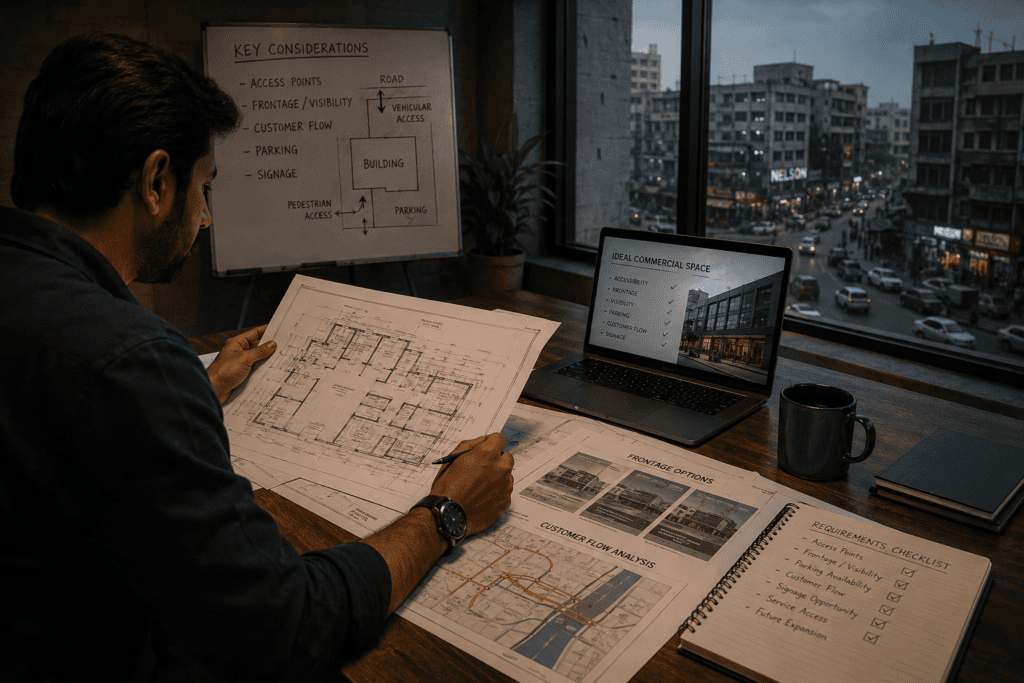
Commercial space should either help the business operate effectively, attract customers, protect professional credibility, or generate rental income. In some cases, it needs to perform more than one of these roles.
Begin by identifying the main value the unit must provide:
- Walk-in sales
- Scheduled client meetings
- Staff workspace
- Product display
- Storage and fulfillment
- Brand visibility
- Rental income
- Long-term commercial ownership
A business that depends on walk-in customers needs visibility and easy access. A professional services firm may gain more from privacy, parking, efficient room division, and a presentable reception.
Investors should assess the likely tenant rather than choosing solely according to personal preference. A space that suits a particular business type may be easier to lease to similar operators, but expected demand and rental income should never be treated as guaranteed.
Customer-facing retail, professional office, or flexible commercial use
Customer-facing businesses usually need a space that can be noticed, entered, and understood quickly. The entrance, signage, frontage, ground-floor position, surrounding activity, and ease of stopping nearby can directly affect customer behaviour.
Professional offices work differently. Clients may already know where they are going, so street visibility becomes less important than accessibility, building image, parking, lift availability, privacy, and an efficient internal layout.
Flexible commercial units can suit businesses that combine several functions. An online retailer, for example, may require a small display area, staff workspace, stock storage, and access for deliveries. The unit must be assessed against all four requirements rather than classified only as a shop or office.
Before reviewing individual commercial properties for sale in Karachi, define the business model clearly. This will make it easier to remove attractive but unsuitable units from consideration.
When a shop is the better choice
A shop is generally the stronger option when customers need to see the business, enter without an appointment, inspect products, or make quick purchasing decisions.
Street-facing shops can suit convenience retailers, pharmacies, salons, food businesses, service counters, mobile and electronics sellers, and other businesses that benefit from frequent public interaction. The exact suitability depends on the surrounding market, permitted use, access, and the physical condition of the unit.
A shop may also be appropriate when signage and brand presence matter. A visible commercial position can serve as a consistent point of contact, but visibility alone does not guarantee sales. The surrounding audience must match the business.
Footfall, frontage, visibility, and repeat customers
Footfall should be observed rather than assumed. Visit the location on working days, evenings, and weekends where relevant. Count the type of people passing the unit and consider whether they resemble the intended customer.
A busy street may still be unsuitable if pedestrians cannot stop, parking is difficult, or customers pass through without shopping. A quieter location can perform better when it serves a concentrated residential or business catchment.
Review the following before selecting a shop:
- Width and visibility of the frontage
- Space for permitted signage
- Distance from the main entrance or road
- Pedestrian and vehicle movement
- Nearby businesses and competing uses
- Customer parking or short-stop access
- Delivery and loading arrangements
- Shutter, entrance, and security configuration
- Water, drainage, ventilation, and power requirements
- Restrictions on operating hours or business activities
Repeat customers can be more valuable than raw footfall. A neighbourhood business may not need the busiest commercial road if it is easy for nearby residents to access regularly.
A shop is less suitable when the business depends mainly on long meetings, confidential discussions, concentrated staff work, or a calm professional environment. Paying for prime frontage brings little benefit when customers rarely walk in.
When an office makes more sense
An office is usually a better fit for professional services, corporate teams, consultancies, agencies, technology businesses, back-office operations, and appointment-led businesses.
The value of an office comes from functionality. Staff should be able to reach it, clients should be able to find it, and the layout should support the way the organisation works.
A lower purchase price does not automatically make an office practical. Poor lift access, inadequate parking, an awkward floor plan, excessive noise, or unsuitable building management can affect the business every day.
Access, parking, privacy, layout, and client visits
Access should be examined from the perspective of both employees and clients. Consider travel routes, public transport where relevant, road congestion, entrance visibility, reception arrangements, and the condition of common areas.
Parking becomes especially important when clients visit regularly. Ask how spaces are assigned, whether visitor parking exists, and whether employees will need alternative arrangements nearby.
Privacy requirements vary by business. Lawyers, consultants, healthcare-related service providers, financial professionals, and management teams may need enclosed rooms and controlled access. A large open-plan area may appear efficient but become expensive to divide later.
The office layout should support:
- Reception and waiting space
- Private rooms or meeting rooms
- Staff workstations
- Storage and record-keeping
- Pantry and washroom access
- Natural light and ventilation
- Internet, power, and equipment requirements
- Emergency exits and lift access
Businesses buying for their own use should consider whether the office can support expected staff growth. Investors should examine how easily the layout can serve different tenants without major alterations.
An office that is highly customised for one operator may be harder to adapt later. Flexible room proportions and practical utility placement can make the unit useful to a broader range of occupants.
When a retail unit inside a mall or mixed-use project fits
A retail unit inside a mall or mixed-use project can suit businesses that benefit from organised surroundings, shared facilities, controlled access, and an existing residential or visitor catchment.
Fashion, food, electronics, personal care, speciality retail, and service brands may benefit from being grouped with complementary businesses. A mixed-use project may also place retailers close to residents, office workers, and regular visitors.
The location of the unit inside the project matters. A unit close to an entrance, lift, escalator, food area, anchor tenant, or frequently used passage may perform differently from one in a less visible section.
Built-in catchment, operating rules, and service charges
A built-in catchment can reduce dependence on street visibility, but buyers should investigate how that catchment is expected to use the project. Residential occupancy, office activity, visitor circulation, access points, and the wider tenant mix all influence commercial potential.
Operating rules should be reviewed before purchase. A managed retail environment may set requirements for:
- Opening and closing times
- Signage and branding
- Shopfront design
- Fit-out approvals
- Deliveries and loading
- Waste management
- Use of common areas
- Noise and permitted activities
- Security procedures
- Temporary closures
These rules may create consistency, but they can also limit flexibility. A business that needs late operating hours, frequent deliveries, outdoor display, specialised exhaust systems, or heavy equipment must confirm whether the premises can support those requirements.
Service charges should be included in the financial comparison. Shared security, cleaning, lifts, air-conditioning, parking management, and common-area maintenance may improve the operating environment, but the recurring cost affects both owner-occupiers and investors.
Request written clarification where charges, fit-out requirements, or usage rules are not confirmed. Do not base the decision on verbal assumptions.
Compare total costs and operating requirements
The purchase price is only the starting point. Two units with similar prices may require very different levels of investment before the business can open.
Prepare a full-cost estimate that covers:
- Booking and payment-plan obligations
- Possession-related amounts
- Documentation and transfer-related costs disclosed by the seller
- Interior construction and fit-out
- Electrical and networking work
- Signage and shopfront preparation
- Furniture, shelving, and equipment
- Air-conditioning or ventilation requirements
- Security arrangements
- Parking costs where separate
- Building or project service charges
- Ongoing maintenance
- Moving and opening expenses
Keep any unconfirmed amount marked as pending. Estimated figures should not be presented as final costs until written details are available.
Operating requirements deserve the same attention. A food business may need drainage, gas arrangements, ventilation, waste handling, and delivery access. A technology office may prioritise stable power, internet connectivity, backup systems, and cooling. A retailer may need storage, display depth, changing rooms, or high electrical capacity.
Self-use buyers should calculate whether the space improves business operations enough to justify the commitment. Investors should compare expected income against service charges, vacancy risk, maintenance, fit-out expectations, and the types of tenants the unit can realistically accommodate.
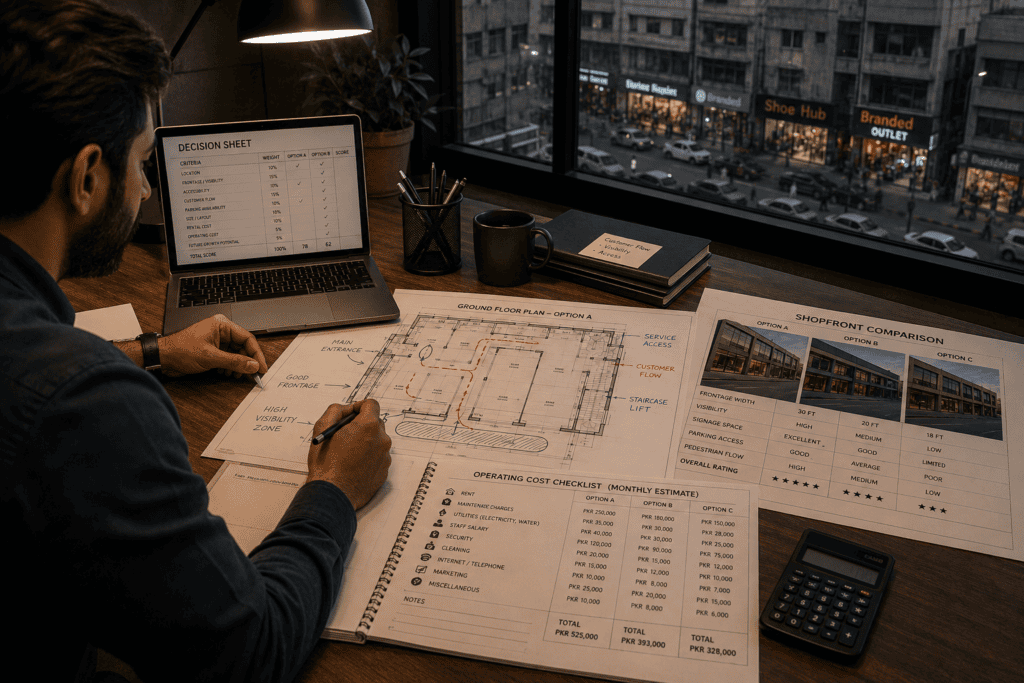
Quick business-type comparison table
| Decision factor | Shop | Office | Retail unit in a mall or mixed-use project |
| Best suited to | Walk-in sales and public-facing services | Professional, administrative, and appointment-led work | Organised retail and services seeking project-based catchment |
| Main value | Street presence and direct customer access | Privacy, staff functionality, and client meetings | Shared environment, managed access, and internal customer movement |
| Visibility need | Usually high | Often moderate | Depends heavily on internal position |
| Parking importance | High for destination businesses | High for staff and client visits | Depends on the project’s parking arrangements |
| Layout priority | Frontage, display, storage, customer flow | Workstations, rooms, reception, privacy | Shopfront, display, storage, and compliance with fit-out rules |
| Operating flexibility | Depends on location and local restrictions | Usually tied to building rules | Often controlled by project management |
| Recurring costs | Maintenance and utilities | Building maintenance and utilities | May include higher shared service charges |
| Main risk | High visibility but weak customer relevance | Affordable space with poor access or inefficient layout | Strong presentation but restrictive rules or weak internal position |
Use the table to remove clearly unsuitable options, then compare the remaining units through site visits, written cost details, operating requirements, and business-specific checks.
FAQ
What is the main difference between a shop and a retail unit in Karachi?
A shop commonly refers to a commercial space with direct street or market access, while a retail unit may be located inside a mall or mixed-use project. The exact terminology can vary, so buyers should focus on access, frontage, operating rules, service charges, and permitted use rather than the label alone.
Is a shop or office better for investment?
Neither is automatically better. The result depends on location, tenant demand, layout, building management, recurring costs, and how easily the unit can serve future occupants. Any expectation of rental or appreciation should be evaluated carefully rather than treated as certain.
Which commercial unit is suitable for a consultancy?
A professional office is often more suitable because consultancies usually need meeting space, privacy, staff work areas, and convenient client access. A shop may work when high visibility and walk-in enquiries are central to the business.
Should I buy a street-facing shop or a unit inside a mall?
Choose according to the target customer and operating model. A street-facing shop may offer direct visibility and flexibility, while a mall or mixed-use unit may provide organised surroundings and an internal catchment. Compare access, unit position, rules, service charges, parking, and expected customer behaviour.
What should I check before buying an office in Karachi?
Review road access, parking, lift availability, common areas, internal layout, utilities, privacy, building management, maintenance costs, permitted use, and the amount required to make the office operational.
How do I compare the total cost of different commercial units?
Add the purchase obligation, possession-related amounts, fit-out, utilities, equipment, signage, parking, service charges, maintenance, and opening costs. Keep missing amounts marked as unconfirmed until written information is available.
Can a single commercial unit serve as both an office and a shop?
Some flexible units may support mixed use, but buyers must confirm the permitted activity, access, building rules, utilities, signage rights, customer movement, and fit-out requirements. The physical layout alone does not confirm that both uses are allowed.
The right choice in a shop vs office vs retail space comparison in Karachi depends on how customers reach the business, how the team works, what the unit costs to operate, and whether the building supports the intended activity.
A shop usually makes sense when frontage and walk-in access drive revenue. An office is stronger when privacy, staff productivity, and scheduled client visits matter more. A retail unit inside a mall or mixed-use project can fit businesses that value a managed setting and built-in catchment, provided the operating rules and service charges remain practical.
Buyers can review ZGC’s new projects in Karachi on installments and compare available commercial options against their business type, access requirements, layout needs, and investment goal. Before making a shortlist, use practical criteria for choosing a commercial property in Karachi for your business to identify the location and unit features that warrant closer review.
The strongest commercial space is not simply the most visible or the least expensive. It is the unit that supports the customer journey, remains financially manageable, and can operate without major compromises.