

Buying a shop, office, or retail unit requires more than checking the price, location, and expected rental return. The property must also have a clear ownership trail, an approved commercial use, manageable dues, practical access, and transfer conditions that do not create problems after payment.
Commercial property due diligence in Karachi should begin before the buyer pays a substantial amount or signs documents that are difficult to reverse. Verbal assurances from a seller, agent, tenant, or project representative should be supported by documents that can be reviewed independently.
The checks below focus specifically on commercial property. They do not replace advice from a qualified property lawyer, tax adviser, architect, engineer, or relevant authority where professional verification is needed.
Confirm the seller and ownership trail
Begin by confirming who legally owns the property and whether the person offering it has the authority to sell it. Compare the name on the seller’s CNIC with the ownership, allotment, lease, transfer, or title documents presented for the transaction.
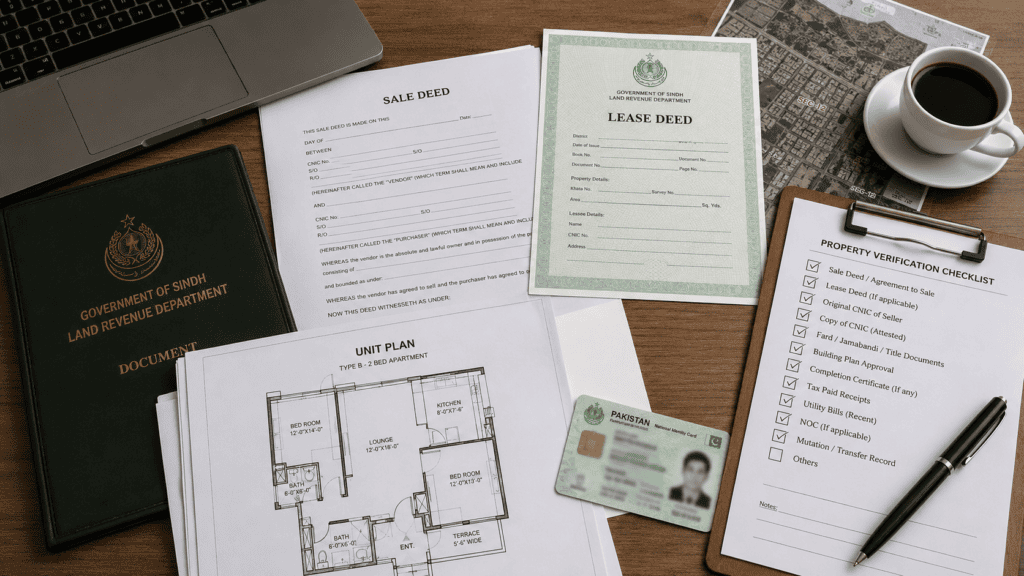
Where someone is acting through a power of attorney, company authority, inheritance arrangement, or another representative capacity, ask for the complete supporting documents. Do not assume that possession of the unit, collection of rent, or access to original papers automatically proves the right to sell.
Review the ownership trail from the current seller back through earlier transfers where relevant. The exact documents will depend on whether the property is leased, allotted, sub-leased, privately developed, located in a managed project, or held under another arrangement.
Your document review may include:
- Ownership, title, lease, allotment, or sub-lease documents
- Previous sale and transfer documents
- Seller’s CNIC and contact information
- Approved power of attorney, where applicable
- Company authorisation for a corporate seller
- Inheritance or succession documents, where relevant
- Possession and handover papers
- Unit, plot, shop, or office identification details
- Mutation or record entries where applicable
- Original receipts and payment records
The Board of Revenue Sindh provides public access to several types of land and property records, including Karachi property registers and an online registry-search facility. Its website also notes that online registration-deed information is not necessarily complete, which means an online result should be treated as a preliminary check rather than the only proof of title.
Compare the property number, survey details, project name, floor, unit number, area, and boundaries across every document. Even a small inconsistency should be clarified before the transaction moves forward.
Verify permitted commercial use and project approvals
A unit that physically looks like a shop or office is not necessarily approved for the business the buyer intends to operate. Confirm the authorised use of the land, building, floor, and individual unit.
This check is particularly important when a residential property has been converted for business activity, when a unit has changed use, or when different floors within the same building have different approved purposes.
Before shortlisting a commercial property in Karachi, ask for written information about its approved designation and whether the intended business activity is permitted at that location.
SBCA describes its regulatory role as including the approval of building plans and NOCs. Buyers should therefore verify the relevant project or building approvals with the authority responsible for that particular property rather than relying only on a brochure, advertisement, or photocopy supplied during negotiations.
Land use, building plan, NOC, and unit designation
Request the records relevant to the property and project. Depending on the transaction, these may include:
- Approved land use
- Approved building plan
- Relevant NOC or sale permission
- Project approval documents
- Unit designation as a shop, office, showroom, or other commercial use
- Approved floor and building configuration
- Completion or occupancy-related documents where applicable
- Permission for alterations or changes of use
- Fit-out and signage rules
- Restrictions on particular business activities
Match the unit being sold with the approved plan. Confirm its floor, number, location, dimensions, access, and intended use.
A project-level approval does not automatically answer every unit-level question. Ask whether the specific shop or office appears in the approved documentation and whether its current physical layout matches the approved plan.
Do not describe a project or unit as approved unless the relevant evidence has been checked. When documents are missing or unclear, mark the approval status as unverified and seek professional confirmation.
Review dues, taxes, leases, and transfer conditions
A property can have a clear physical condition yet still carry unpaid charges or contractual obligations. Ask for a written statement showing which amounts have been paid and which remain outstanding.
Check for:
- Project or developer instalments
- Maintenance and service charges
- Utility bills
- Parking charges
- Authority or lessor dues
- Ground rent or lease-related payments
- Property-related taxes
- Transfer, documentation, and processing charges
- Penalties or late-payment amounts
- Fit-out or renovation deposits
Do not assume the seller’s quoted price includes every transfer-related cost. Request a written breakdown showing what the buyer will pay, what the seller will clear, and which charges remain subject to confirmation.
Where the unit is rented, review the complete lease arrangement. Confirm the tenant’s identity, rent, security deposit, lease duration, renewal terms, notice period, maintenance responsibility, and any outstanding amounts.
Ask whether the sale will take place with the tenant in possession or after the unit has been vacated. The agreement should clearly state how the security deposit, advance rent, keys, inventory, and possession will be handled.
Assess location, frontage, access, and parking
Commercial location should be judged according to the intended business or tenant. A visible shop with strong pedestrian movement may suit a retailer, while an office buyer may place more value on parking, lift access, privacy, and an easy client route.
Visit the property at different times and review:
- Vehicle and pedestrian movement
- Visibility from the road or internal walkway
- Width and condition of the frontage
- Signage opportunities and restrictions
- Customer entry and exit
- Delivery and loading access
- Traffic and turning difficulties
- Public transport where relevant
- Security around the building
- Access during evenings and weekends
- Nearby competing and complementary businesses
Confirm parking rather than assuming it is included. Ask whether the space is allocated, shared, paid, reserved, or subject to building-management rules.
A shop with heavy footfall may still be weak for a destination business if customers cannot stop nearby. An office with a good address may create daily problems if employees and visitors cannot park or reach the floor conveniently.
Inspect the unit and common commercial facilities
Inspect the property with the intended business use in mind. Cosmetic finishes matter, but plumbing, power, ventilation, structural condition, access, and fit-out requirements may have a greater financial impact.
Check the unit for:
- Cracks, dampness, leakage, and damaged finishes
- Flooring and ceiling condition
- Doors, shutters, windows, locks, and glazing
- Electrical load and distribution
- Sockets, lighting, and meter arrangements
- Water supply and drainage
- Washroom condition
- Ventilation and air-conditioning provisions
- Internet and communication access
- Storage and service areas
- Emergency and secondary exits where relevant
- Space for signage, counters, equipment, or partitions
Inspect common facilities as well. Lifts, stairs, corridors, entrances, parking areas, loading access, waste handling, fire-safety installations, and backup arrangements affect the usability of the commercial unit.
Record any untested or unavailable system as pending. Do not treat verbal confirmation as a completed inspection.
Check tenant, vacancy, and operating restrictions
For an investment purchase, ask for evidence supporting the current rent and tenancy status. A claimed rental amount should not be treated as established income without reviewing the lease and payment history.
Confirm:
- Whether the unit is occupied or vacant
- Current rent and payment schedule
- Rent arrears, if any
- Security deposit held
- Lease expiry and renewal provisions
- Tenant notice requirements
- Responsibility for utilities and maintenance
- Restrictions on eviction, vacancy, or possession
- Whether the existing use is permitted
- Whether the tenant has altered the property
Vacancy also deserves investigation. A unit may be empty because the seller recently received possession, but repeated vacancy can indicate weak access, high charges, poor layout, operating restrictions, or limited tenant demand.
Owner-occupiers should review building and project rules before payment. Confirm permitted operating hours, signage, customer access, deliveries, noise, food preparation, exhaust systems, generators, renovations, and any activity-specific restrictions.
Final professional review before payment
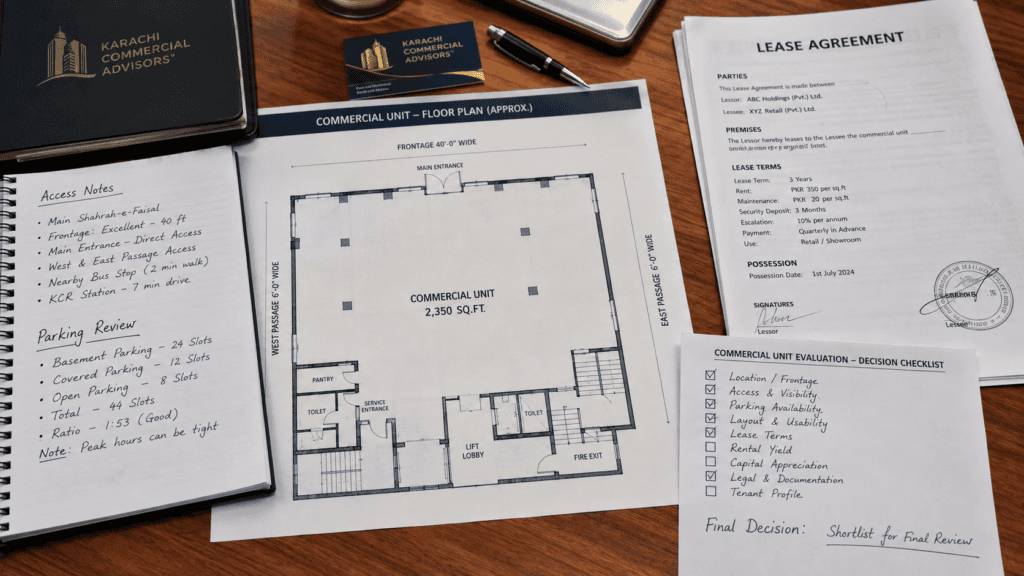
Organise the due-diligence findings into a written checklist before paying a major amount. Separate confirmed facts from pending items and unresolved concerns.
| Area | Status to record |
| Seller’s identity and authority | Confirmed, pending, or inconsistent |
| Ownership trail | Complete or documents missing |
| Commercial use | Verified or unverified |
| Building and project approvals | Reviewed or pending verification |
| Dues and taxes | Cleared, outstanding, or not confirmed |
| Lease status | Vacant, occupied, or unclear |
| Access and parking | Suitable or unsuitable |
| Physical condition | Acceptable, repair needed, or specialist inspection required |
| Transfer conditions | Confirmed in writing or pending |
| Professional review | Completed or still required |
Ask a qualified property lawyer to review the ownership documents, transaction structure, transfer requirements, seller authority, and draft agreement. Tax and payment obligations should be checked with an appropriate adviser rather than estimated informally.
Any payment conditions, defect commitments, vacant-possession terms, included fixtures, parking rights, and outstanding dues should be reflected in writing. Do not leave material promises outside the agreement.
FAQ
What is commercial property due diligence?
Commercial property due diligence is the process of reviewing ownership, permitted use, approvals, dues, leases, access, physical condition, transfer requirements, and business suitability before completing a purchase.
Which documents should I check before buying a shop in Karachi?
The documents depend on the property, but buyers may need to review ownership or lease records, previous transfers, seller identification, approved plans, relevant NOCs, unit designation, payment records, dues, and tenancy documents.
How can I confirm that a unit is approved for commercial use?
Check the approved land use, building plan, project documents, unit designation, and permissions relevant to the property. Verification should be obtained from the responsible authority and reviewed by a qualified professional where necessary.
Should I buy a commercial unit with an existing tenant?
An occupied unit may suit an investor, but the lease, rent history, deposit, notice terms, tenant obligations, and possession arrangements must be reviewed. Existing tenancy should not be treated as guaranteed future income.
What dues should be cleared before transfer?
Potential dues may include developer instalments, maintenance charges, utility bills, taxes, lease-related charges, parking charges, penalties, and transfer fees. The applicable amounts vary, so request written clearance and a transaction-specific breakdown.
Is online property verification enough?
No. Online records can support an initial review, but they may not contain every record or resolve every ownership and transfer issue. Original documents, certified records where required, authority confirmation, and professional legal review remain important.
When should I pay the booking or advance amount?
The payment schedule depends on the transaction, but buyers should complete reasonable preliminary verification and ensure that refund, adjustment, and transaction conditions are written clearly before making a substantial payment.
Commercial property due diligence in Karachi should answer three basic questions: does the seller have the right to transfer the unit, is the property legally and practically suitable for the intended commercial use, and are the financial and possession conditions clear?
A strong location or attractive price should not override missing ownership records, unclear approvals, unpaid dues, restrictive leases, weak access, or an unsuitable unit designation.
Buyers can compare ZGC’s new projects in Karachi after defining the business type, frontage, parking, layout, and investment requirements that matter to them. The ownership and approval stage should then be supported by a structured process for verifying property documents before buying in Karachi.
The goal is not to make the transaction unnecessarily complicated. It is to identify the questions that must be resolved before payment, document the answers, and involve the right professionals wherever the buyer cannot verify a material issue independently.