

Buying a commercial unit for your own business and buying one to earn rent may involve the same property market, but they are two different decisions. A space that works well for an owner-operated business may be difficult to lease, while a unit with strong tenant appeal may not suit the way your own company operates.
A commercial property self-use vs rental Karachi comparison should therefore begin with the purpose of the purchase. Self-use buyers need control, operational fit, access, and stability. Rental-focused buyers need tenant demand, realistic income expectations, manageable vacancy risk, and an asset that remains attractive to future occupants.
Neither objective is automatically better. The stronger choice is the one that matches your cash flow, business plans, risk tolerance, and expected holding period.
Define whether the property must support a business or produce income
Before comparing individual shops or offices, decide what the property is expected to do.
For a self-use buyer, the property is part of the business infrastructure. It needs to help employees work efficiently, make it easy for customers or clients to visit, support required equipment, and provide enough flexibility for future operational changes.
For a rental-income buyer, the property is primarily an income-producing asset. The focus shifts towards tenant demand, achievable rent, vacancy periods, lease structure, maintenance obligations, and how easily another tenant could use the unit later.
Some buyers expect to do both. They may occupy the unit for several years and rent it out later, or purchase a larger property and lease part of it. In that case, both business suitability and future tenant appeal should be considered from the beginning.
A useful first test is to answer these questions:
- Will my own business occupy the unit immediately?
- Is regular rental income the primary goal?
- Could the intended use change within five to ten years?
- How dependent is the purchase decision on expected rent?
- Would I still want this property if rental income were temporarily unavailable?
- Would another business be able to use the space without major alterations?
Clarifying the purpose before you buy commercial property in Karachi helps prevent a common mistake: selecting a unit because it appears commercially attractive without checking whether it suits the actual objective of the purchase.
Buying for self-use
Self-use changes the way commercial property should be evaluated. Rental yield becomes less important than the cost and operational benefit of controlling your own premises.

A business owner may value a unit because it eliminates uncertainty around lease renewals, gives greater control over the fit-out, or provides a location that supports customers and employees over a longer period.
The property still needs to make financial sense, but its value is not measured only by rent.
Control, customization, operating stability, and business fit
Ownership can provide greater control over how the unit is configured, subject to building rules, permitted use, approvals, and other applicable restrictions.
A retailer may need display frontage, storage, signage, customer access, and delivery space. A professional office may care more about meeting rooms, privacy, parking, lifts, reception space, and staff access.
Before choosing a self-use unit, assess:
- Whether the permitted use matches the business
- Customer or client access
- Employee commute and parking
- Frontage and visibility where relevant
- Internal layout
- Electrical and utility requirements
- Storage requirements
- Signage opportunities
- Loading or delivery access
- Building operating hours
- Fit-out restrictions
- Space for future staff or equipment
Customization deserves particular attention. A unit may be physically large enough but still require expensive partitioning, ventilation work, wiring, plumbing, counters, shelving, or specialist equipment before the business can operate.
These costs should be added to the purchase budget rather than treated as an afterthought.
Operating stability is another reason some business owners prefer ownership. A long-term premises strategy may reduce exposure to lease-renewal negotiations or the need to relocate because a landlord changes terms.
Ownership creates different obligations in return. The business becomes responsible for the capital tied up in the property, ongoing building expenses, repairs, and the difficulty of exiting quickly if operational needs change.
Buying for rental income
A rental-focused commercial purchase should be judged by the tenant market rather than the buyer’s personal preferences.
The question is not whether you like the unit. It is whether suitable businesses are likely to want it, whether they can afford the rent required to support your investment case, and how easily the space could be leased again after a tenant leaves.
Rental income should always be treated as an expectation rather than a guaranteed return.
Tenant demand, vacancy, lease terms, and yield
Tenant demand can vary substantially between commercial locations and unit types in Karachi. A ground-floor shop, upper-floor office, mall unit, and mixed-use commercial space may attract completely different occupants.
Look at the likely tenant profile:
- Retailers
- Professional offices
- Clinics or service businesses
- Food operators where permitted
- Corporate teams
- Small businesses
- Established brands
- Local service providers
The wider the practical tenant pool, the less dependent the investment may be on finding one very specific type of occupant.
Vacancy is one of the main risks. A unit producing no rent still carries ownership costs. Building service charges, maintenance, taxes or government charges where applicable, financing obligations, and repairs do not necessarily stop because the property is empty.
Lease terms also affect the quality of rental income. Review:
- Lease duration
- Rent review or escalation terms
- Security deposit
- Renewal conditions
- Notice period
- Maintenance responsibility
- Fit-out responsibility
- Utility responsibility
- Restrictions on subletting
- Conditions for restoring the unit when the tenant leaves
Yield should be evaluated using realistic income and realistic expenses.
A simple gross yield comparison looks at annual rent relative to the property purchase price. A more useful net assessment also considers vacancy, service charges, repairs, leasing expenses, and other ownership costs.
Do not use an advertised or expected rental figure as if it were confirmed income. Check comparable occupied units, actual lease evidence where available, and the condition of the local tenant market.
Compare location and unit type for each goal
Location matters for both strategies, but not for exactly the same reasons.
A self-use buyer should judge the property according to the business’s customers, staff, suppliers, and operating model. Paying more for frontage may be justified for a retailer that depends on visibility but unnecessary for a back-office operation.
A rental investor should think about the location from the perspective of multiple future tenants.
For self-use, ask:
- Does the location support our customer base?
- Can employees reach it conveniently?
- Is parking sufficient for our actual operation?
- Does the surrounding area fit our business image?
- Can deliveries and suppliers access the property?
- Is the space usable during our required operating hours?
For rental income, ask:
- Which businesses are already operating nearby?
- What types of tenants could use this unit?
- Would several tenant categories find the location workable?
- Is access likely to discourage potential occupants?
- Does the unit depend heavily on one particular customer catchment?
- Are there competing vacant units nearby?
Unit type also matters.
A highly visible shop may suit owner-operated retail and also appeal to future retailers. An office with practical parking, lifts, flexible partitions, and usable floor space may serve both an owner-user and multiple professional tenants.
Highly specialised spaces deserve more caution. A property designed around one business model may work extremely well for self-use but require substantial modification before another tenant can occupy it.
Compare costs, risk, and exit flexibility
Self-use and rental purchases create different financial risks.
The self-use buyer should compare the cost of ownership with the practical alternative of continuing to rent business premises. That comparison should include the purchase price, fit-out, financing where applicable, maintenance, building charges, and capital tied up in the property.
The business should also consider opportunity cost. Money committed to real estate cannot simultaneously be used for inventory, staff, equipment, marketing, expansion, or other business needs.
Rental investors face a different set of risks:
- Vacancy
- Tenant default
- Rent below expectation
- Fit-out periods between tenants
- Repair costs
- Building service charges
- Leasing expenses
- Changes in tenant demand
- Difficulty selling quickly
- Dependence on the wider commercial market
Tax, transfer, documentation, and other transaction costs should also be included, but the applicable amounts can vary by transaction and buyer circumstances. Obtain current figures from the relevant professionals and authorities rather than relying on generic estimates.
Liquidity deserves attention under both strategies. Commercial property cannot usually be converted into cash as quickly as a liquid financial asset.
A self-use owner may also find it difficult to relocate quickly if the business outgrows the property. A rental investor may need to accept a longer sale period or different price expectations if market conditions are weak when an exit is required.
Think about the exit before making the purchase:
- Could your own business outgrow the unit?
- Could the property be leased if the business relocates?
- Would other businesses find the layout practical?
- Is the unit heavily customised?
- Could it be divided or adapted without major work?
- Are there restrictions that could narrow future demand?
The more adaptable the unit, the more options the owner may retain.
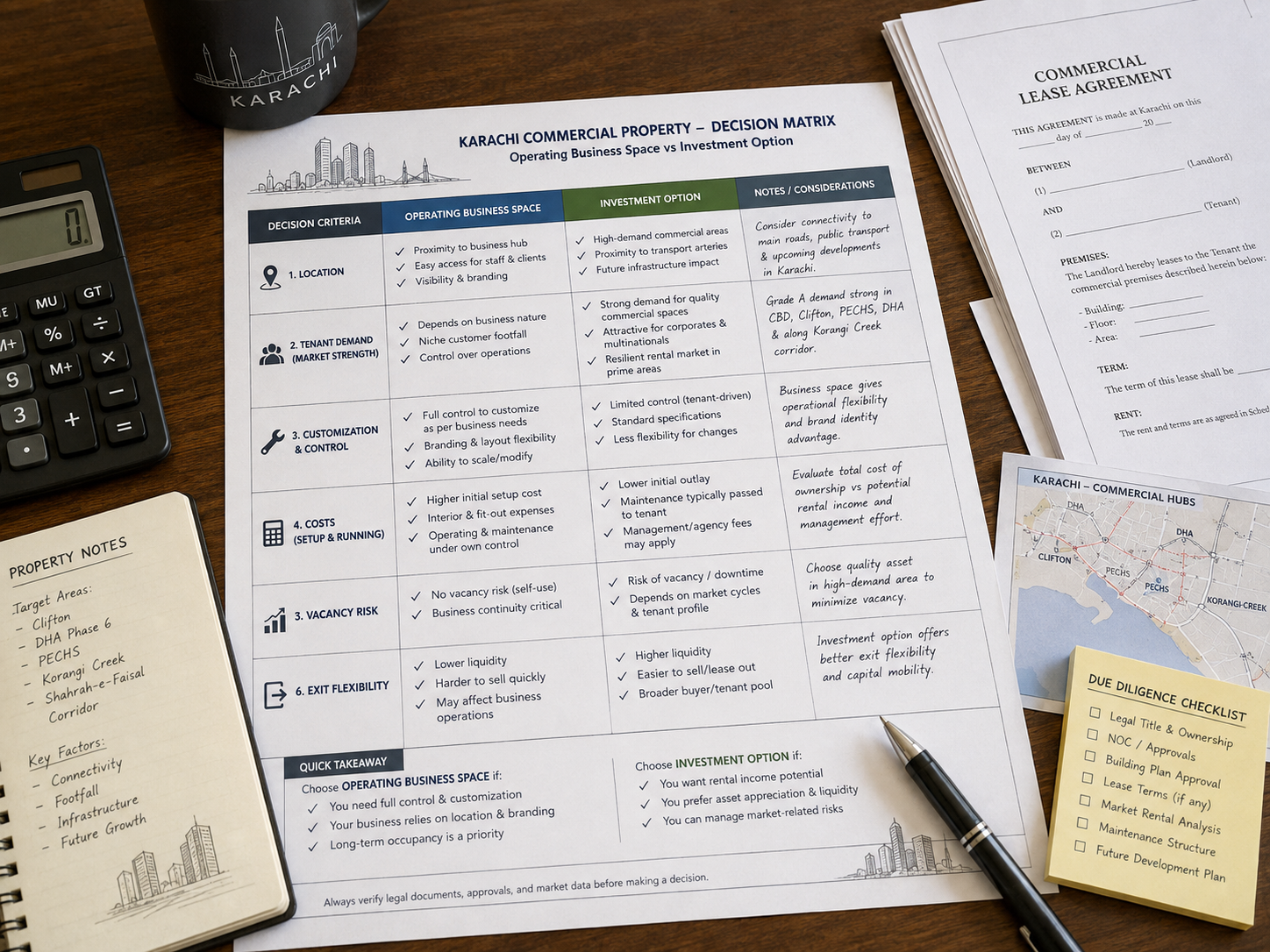
Decision table: self-use vs rental income
| Decision factor | Self-use purchase | Rental-income purchase |
| Primary objective | Support business operations | Produce rental income |
| Main location test | Customer, staff, supplier and operational access | Tenant demand and reletting potential |
| Layout priority | Exact business requirements | Flexible use for multiple tenant types |
| Frontage | Valuable when the business depends on visibility | Valuable if target tenants require it |
| Customization | Can be tailored to the owner’s business | Excessive specialization may reduce tenant appeal |
| Parking and access | Based on actual staff/client requirements | Based on likely tenant categories |
| Income consideration | Savings versus renting may matter | Rent, vacancy and net yield are central |
| Main risk | Business outgrows or no longer needs the unit | Vacancy, tenant default or weak demand |
| Fit-out approach | Business-specific where permitted | Prefer adaptable improvements |
| Exit flexibility | Can potentially rent or sell later | Sell, re-lease or reposition for another tenant |
| Best fit | Established business with clear long-term premises needs | Buyer comfortable with tenant and vacancy risk |
The table should be used as a decision framework rather than a scoring system. A property can perform well under both strategies when its location, layout, access, and commercial use remain flexible.
FAQ
Is it better to buy commercial property for self-use or rental income in Karachi?
Neither option is automatically better. Self-use may suit businesses seeking long-term control and operational stability, while rental ownership may suit buyers focused on income. The decision depends on business requirements, cash flow, tenant demand, risk tolerance, and holding period.
What are the main benefits of buying commercial property for my own business?
Potential benefits include greater control over the premises, the ability to customize the unit where permitted, reduced dependence on lease renewals, and a location that can be planned around long-term business needs.
What is the biggest risk when buying commercial property for rental income?
Vacancy is one of the most important risks because ownership expenses can continue even when no rent is being received. Tenant default, repairs, weak leasing demand, and reletting costs should also be considered.
How should I estimate commercial rental income in Karachi?
Review realistic rent for comparable occupied properties and examine the tenant market for that location and unit type. Do not base the investment decision only on advertised rent or an assumed future figure.
Should I buy a highly customized commercial unit for investment?
A highly specialized unit may have a smaller future tenant pool unless there is consistent demand for that particular use. Rental-focused buyers should consider how easily the space can be adapted for different occupants.
Does location matter differently for self-use and rental property?
Yes. Self-use buyers should prioritize the needs of their own customers, employees, suppliers, and operations. Rental investors should consider how the location works for several potential tenant categories rather than only one business.
Can I buy a commercial unit for my business and rent it out later?
Potentially, yes, provided the unit remains suitable for tenants and its permitted use, building rules, lease arrangements, and other applicable requirements allow it. Buyers planning this strategy should avoid unnecessary customization that makes future leasing difficult.
Conclusion
A commercial property self-use vs rental Karachi decision becomes clearer once the purpose of the purchase is defined. Self-use buyers should prioritize operating fit, control, accessibility, and long-term business stability. Rental investors need to focus more heavily on tenant demand, vacancy, lease structure, realistic income, and adaptability.
Buyers can compare ZGC’s current projects in Karachi after deciding which objective matters most. A self-use buyer can then judge each option against actual business requirements, while an investor can evaluate the same unit from the perspective of future tenants.
Commercial options such as Capital Center and City Center Shopping Mall can be reviewed using this same framework: intended use first, then location, unit type, costs, flexibility, and risk. The stronger purchase is not simply the property with the most attractive headline return or the most prominent location; it is the one that remains useful under the ownership strategy you actually intend to follow.