

A project payment plan can look simple when it is reduced to a booking amount and a monthly instalment. The real commitment becomes clear only when you view every payment stage, due date, possession amount, and additional charge together.
Learning how to read a project payment plan in Karachi helps buyers compare projects on affordability rather than marketing presentation. Two units with the same advertised price may place very different pressure on your cash flow because of confirmation payments, quarterly instalments, balloon payments, or large amounts due at possession.
Before paying a booking amount, convert the payment plan into a complete timeline. You should know how much is due, when it is due, what triggers the payment, and which costs are not included in the advertised price.
Understand every line in the payment plan
Start by reviewing the payment schedule line by line. Do not judge the plan only by the lowest monthly figure printed in the brochure.
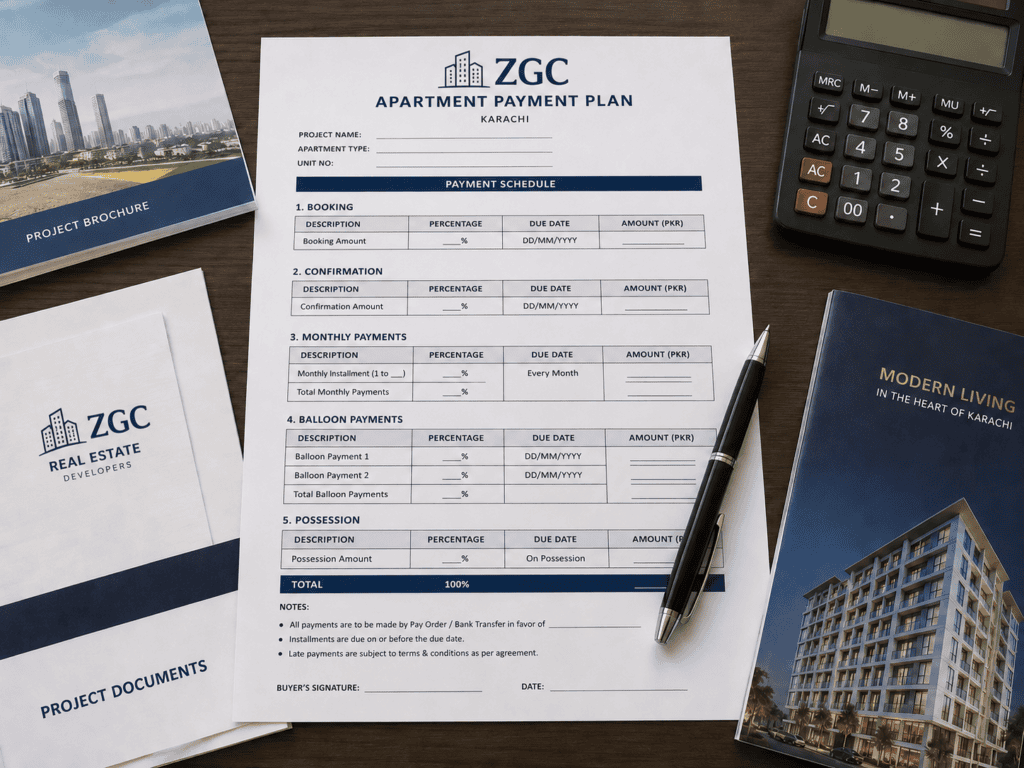
A payment plan should clearly identify:
- The unit’s stated price
- Booking amount
- Confirmation amount
- Monthly or quarterly instalments
- Construction-linked payments
- Balloon payments
- Possession amount
- Additional charges
- Payment due dates
- Conditions attached to each stage
Ask for a written copy that shows amounts in rupees as well as percentages. Percentages can make a schedule look manageable, but actual amounts are easier to compare with your income and savings.
Buyers reviewing new projects in Karachi on installments should place each payment stage on a calendar before shortlisting a unit. This makes periods with unusually heavy payments visible before any commitment is made.
Booking, confirmation, installments, balloon payments, and possession
The booking amount is the initial payment used to reserve a unit. Confirm whether it is refundable, partly refundable, or non-refundable, and under which circumstances.
A confirmation payment may be due shortly after booking. Buyers sometimes focus on the first payment and overlook that another substantial amount may be required within 15, 30, or 60 days.
Instalments may be monthly, quarterly, half-yearly, or linked to construction stages. Check whether all instalments are equal. A plan advertised as “monthly” may still contain larger payments every few months.
Balloon payments are larger amounts due at specific points in the schedule. They may fall after a certain number of months or at a stated construction milestone. These payments can have a greater effect on affordability than the regular instalments.
The possession amount is due when the buyer reaches the handover stage under the project’s terms. It may represent a percentage of the unit price, but possession-related charges outside the price may also apply.
Use a simple schedule like this:
| Payment stage | Due date | Amount | Included in advertised price? |
| Booking | At reservation | Confirm from plan | Yes or no |
| Confirmation | Within stated period | Confirm from plan | Yes or no |
| Regular instalments | Monthly or quarterly | Confirm from plan | Usually |
| Balloon payments | Specific dates or stages | Confirm from plan | Usually |
| Possession | At handover stage | Confirm from plan | Confirm |
| Other charges | As applicable | Pending verification | Often separate |
Any unclear entry should remain marked as pending until the developer or authorised seller explains it in writing.
Match payment dates with construction milestones
Some payment plans are based mainly on dates, while others connect payments with construction progress. Buyers should understand which system applies.
A date-based instalment remains due according to the schedule even if the buyer has not independently reviewed construction progress. A milestone-based payment may be linked to stages such as excavation, structure, finishing, or possession, depending on the project documents.
Ask three questions:
- Is the payment triggered by a calendar date or construction progress?
- How will the buyer be informed that the milestone has been reached?
- What documents define the buyer’s obligations if the timeline changes?
Do not assume that a payment label such as “on structure completion” explains the full contractual position. Review the booking form, allotment documents, payment schedule, and relevant terms together.
The purpose of matching payments with milestones is not to predict completion. It is to understand why each amount becomes due and whether the written agreement supports the same interpretation as the sales discussion.
Identify charges outside the advertised price
The advertised unit price may not represent the full amount required before possession or transfer. Additional charges can materially change the total commitment.
This article focuses on reading the schedule rather than creating a complete hidden-cost list, but the payment plan should still identify which charges sit outside the main price.
Utilities, documentation, parking, maintenance, transfer, and possession
Ask whether the following are included, separate, estimated, or not yet confirmed:
- Utility connection charges
- Documentation or processing fees
- Parking price or allocation charges
- Maintenance or service charges
- Transfer charges
- Possession-related charges
- Meter installation costs
- Development or infrastructure charges
- Late-payment fees
- Taxes or government charges applicable to the transaction
Do not add an estimated charge to the advertised price and treat the result as final. Request a written breakdown and note which figures may change.
A useful format is:
| Cost item | Confirmed amount | When payable | Written evidence received |
| Unit price | Yes/No | ||
| Parking | Yes/No | ||
| Documentation | Yes/No | ||
| Utilities | Yes/No | ||
| Maintenance deposit | Yes/No | ||
| Possession charges | Yes/No | ||
| Transfer-related cost | Yes/No |
Missing figures should not be ignored simply because they are not due immediately. They remain part of the buyer’s financial planning.
Calculate the total amount and monthly affordability
Add every confirmed payment in the schedule before deciding whether the project fits your budget. The total of booking, confirmation, instalments, balloon payments, and possession should reconcile with the stated unit price when those amounts are included in it.
Next, calculate the financial pressure month by month. An average monthly figure can be misleading when the schedule contains quarterly or annual balloon payments.
For example, suppose a hypothetical payment plan shows:
- Booking: PKR 1,000,000
- Confirmation after 30 days: PKR 500,000
- 24 monthly instalments: PKR 150,000 each
- Four quarterly payments: PKR 300,000 each
- Possession payment: PKR 700,000
The total would be:
| Component | Calculation | Amount |
| Booking | Fixed | PKR 1,000,000 |
| Confirmation | Fixed | PKR 500,000 |
| Monthly instalments | 24 × PKR 150,000 | PKR 3,600,000 |
| Quarterly payments | 4 × PKR 300,000 | PKR 1,200,000 |
| Possession | Fixed | PKR 700,000 |
| Illustrative total | PKR 7,000,000 |
This sample is illustrative and does not represent an actual ZGC project.
The regular monthly instalment is PKR 150,000, but the buyer may need PKR 450,000 in a month when a quarterly payment also falls due. The first two months may be heavier because of booking and confirmation.
Affordability should therefore be tested against the highest-payment months, not only the average. Keep room for household expenses, business obligations, emergencies, and possible changes in income.
Check delay, cancellation, and late-payment clauses
The payment schedule shows when money is due. The accompanying terms explain what happens when a payment is late, the buyer cancels, or the project timeline changes.
Review the clauses covering:
- Late-payment penalties
- Grace periods
- Default notices
- Cancellation by the buyer
- Cancellation by the seller or developer
- Deductions from paid amounts
- Refund timing
- Unit restoration or resale
- Changes to construction or possession timelines
- Transfer of the booking to another buyer
- Rescheduling of overdue instalments
Do not rely on a verbal statement that late payments will “not be a problem.” The written terms govern the transaction.
Cancellation clauses deserve particular attention. Confirm what percentage or amount may be deducted, how long a refund could take under the agreement, and whether taxes, commissions, processing fees, or other charges are recoverable.
Where the terms are unclear or the financial commitment is substantial, have the documents reviewed by an appropriately qualified property lawyer or adviser before payment.
Compare two project payment plans using one method
Projects should be compared through the same financial framework. Looking at monthly instalments on one plan and total price on another produces an unreliable decision.
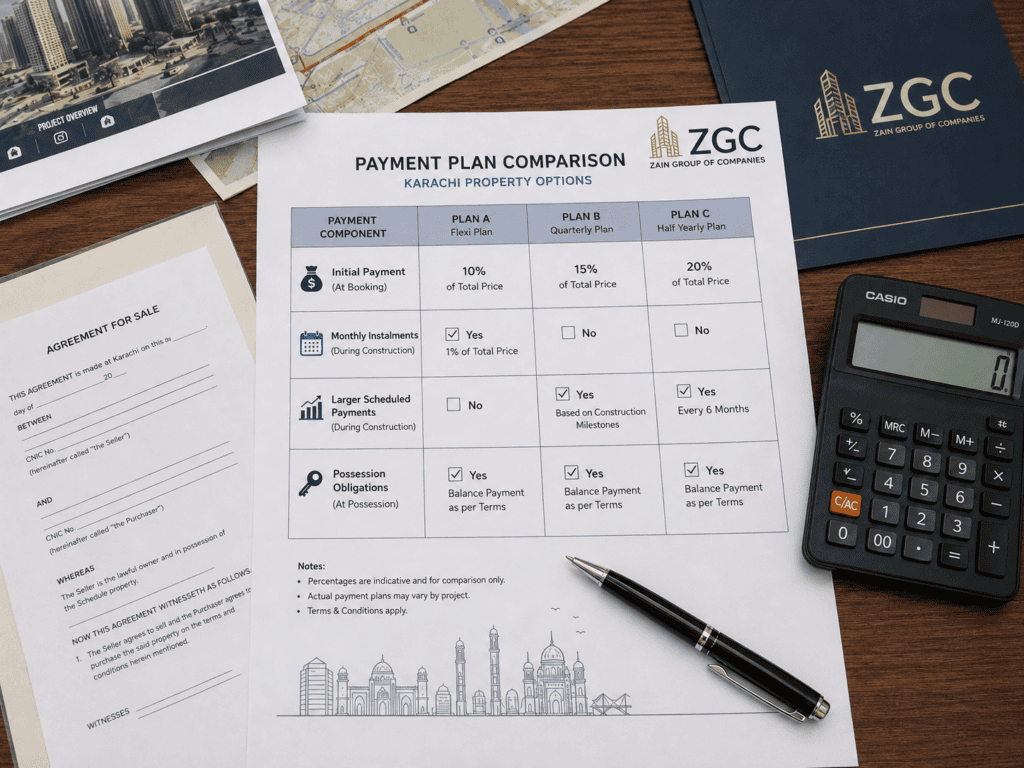
Consider these two hypothetical schedules for units with the same stated price of PKR 8,000,000:
| Payment factor | Plan A | Plan B |
| Booking | PKR 800,000 | PKR 1,600,000 |
| Confirmation | PKR 400,000 | None stated |
| Regular instalments | PKR 150,000 × 32 | PKR 100,000 × 40 |
| Balloon payments | PKR 500,000 × 2 | PKR 400,000 × 4 |
| Possession | PKR 1,000,000 | PKR 800,000 |
| Stated total | PKR 8,000,000 | PKR 8,000,000 |
Both plans reach the same stated price, but they suit different buyers.
Plan A requires less at booking than Plan B, but it carries higher regular instalments and a larger possession payment. Plan B reduces the monthly instalment but requires a higher initial payment and more balloon payments.
Compare each plan using these five measures:
- Total amount payable
- Initial cash required
- Highest payment in any single month
- Amount due before possession
- Additional charges outside the price
The better plan is not automatically the longer one or the one with the lowest monthly instalment. It is the plan that fits the buyer’s actual cash flow with fewer periods of financial strain.
FAQ
What should I check first in a project payment plan?
Start with the total unit price, booking amount, confirmation payment, regular instalments, balloon payments, and possession amount. Confirm that all included payments add up correctly.
Is the monthly instalment the most important figure?
No. Buyers should also consider booking, confirmation, quarterly payments, balloon amounts, possession charges, and costs outside the advertised price.
What is a balloon payment in a property plan?
A balloon payment is a larger payment due at a particular date or construction stage. It is separate from the smaller regular instalments and can create significant cash-flow pressure.
Should payments be linked to construction progress?
That depends on the project’s written terms. Buyers should confirm whether payments are date-based or milestone-based and understand how each milestone is defined and communicated.
How can I identify hidden charges in a payment plan?
Request a written breakdown covering parking, documentation, utilities, maintenance, possession, transfer, taxes, and other charges. Any missing amount should remain marked as unconfirmed.
What happens if I miss an instalment?
The consequences depend on the agreement. They may include penalties, notices, cancellation, or other remedies. Review the late-payment and default clauses before booking.
Can I compare two plans using the advertised monthly payment?
The monthly payment alone is not enough. Compare total cost, initial cash, balloon payments, the highest-payment month, possession obligations, and charges outside the price.
Knowing how to read a project payment plan in Karachi allows buyers to judge the full commitment before booking. Break the schedule into payment stages, map every due date, identify amounts outside the advertised price, and test affordability during the most expensive months.
Buyers comparing residential options can review available apartments for sale in Karachi, while businesses and investors can assess suitable commercial properties using the same disciplined approach to payment timing and total cost.
Before choosing between shortlisted projects, compare the payment schedule with the possible hidden costs in Karachi instalment projects. The right plan is not simply the one that extends payments for the longest period. It is the one whose booking, instalments, balloon payments, possession amount, and additional charges remain manageable together.