

Apartment maintenance charges in Karachi are recurring contributions towards a building’s shared services and upkeep. To assess a quoted fee, request the itemised budget, check which services it includes, confirm how costs are divided, and ask who contributes for vacant units. Compare the complete obligation—including separately billed services and replacement reserves—before deciding whether the apartment fits your budget.
An apartment can fit your purchase budget and still put pressure on your monthly finances. The difference often sits outside the apartment itself: the people, equipment and services needed to keep the building operating.
The lift requires servicing. Shared lights consume electricity. Security staff need an organised roster. Pumps, cleaning and backup systems require attention even when some homes are empty.
When comparing apartments for sale in Karachi, ask for more than a monthly maintenance figure. Ask what that figure funds, how it was calculated and what happens when the underlying assumptions change.
This guide gives you a practical way to examine the budget, including an illustrative 60-apartment model and a worksheet you can use during your next viewing.
What Do Apartment Maintenance Charges Actually Cover?
Maintenance or service charges can cover shared building operations, but the label alone tells you very little. Two projects can use the same term for different packages.
One may include lift servicing and common-area electricity. Another may bill generator fuel and water separately. A third may collect a contribution towards future equipment replacement alongside ordinary monthly expenses.
Start by separating the following categories.
| Cost category | What it might cover | What you should clarify |
|---|---|---|
| Security and access | Guards, visitor management and monitoring | Staffing hours, service scope and responsible contractor |
| Cleaning | Shared corridors, lobbies and waste handling | Areas covered, cleaning frequency and consumables |
| Lift servicing | Scheduled maintenance and inspections | Whether repairs, parts and emergency attendance are included |
| Common-area electricity | Shared lighting, lifts and pumps | Which meters and equipment the budget covers |
| Backup power | Generator operation, servicing or fuel | Common-area versus apartment coverage and separate usage charges |
| Water systems | Pumping, tank cleaning and supply arrangements | Whether purchased water, testing and treatment are additional |
| Management and administration | Billing, records and management services | Defined tasks and any separately charged administration fees |
| Routine repairs | Minor repairs to shared facilities | Spending authority and the distinction from major replacement work |
These are categories to investigate, not a statement that every Karachi building includes them.
Also separate shared maintenance from your apartment’s individual electricity, internet, domestic repairs and other household bills. Ask management to identify any service appearing in more than one billing line so you can check for duplication.
How Much Should Apartment Maintenance Cost in Karachi?
A useful benchmark is the documented cost of operating the particular building under its agreed allocation rules. A quoted amount cannot be judged reliably without its service scope, building budget and payment responsibilities.
A fee copied from another neighbourhood may be misleading. Buildings can have different numbers of units, equipment, staffing arrangements, service hours and replacement needs. Even neighbouring developments may have different obligations.
Ask management whether the quotation is:
- An estimate for an unfinished project.
- A temporary introductory amount.
- A budget approved for a specified period.
- A current charge supported by actual expenditure records.
Those descriptions represent different levels of certainty. An estimate can help with planning, but it should come with assumptions and a clear explanation of what could change.
The sensible question is: “Can you show how this charge funds the services promised for this building?”
The Written Agreement Matters
The Sindh Building Control Authority’s published model agreement for public-sale projects addresses maintenance payments after possession and the role of a residents’ cooperative society in common services. Its payment schedule also leaves a maintenance amount to be mutually agreed.
That document is a useful reason to read the maintenance provisions carefully. It does not establish a current universal fee, allocation formula or charge-start date for every Karachi apartment. Have the applicable project documents and any unclear obligation reviewed for your particular purchase.
Audit the Building Budget in Five Steps
You do not need to reproduce a professional financial audit to ask useful questions. You need enough evidence to understand the fee and identify what remains unconfirmed.
1. Request a Budget With a Defined Period
Ask for a monthly or annual budget with a preparation date and the person or organisation responsible for it. If the budget is annual, divide it by 12 for comparison, while keeping any seasonal or irregular expenses visible.
Check that it identifies operating costs, reserve contributions and separately billed services. A single line labelled “maintenance expenses” is not enough to explain the total.
2. Match Important Costs to Evidence
For an operating building, ask whether management can provide an appropriate summary or redacted sample of relevant invoices, contracts and expenditure statements. Personal employee information and residents’ private details are not needed.
For a new building, quotations, draft service contracts and equipment schedules may support the estimate. Keep projected costs clearly distinguished from bills already incurred.
Record each answer as supported, estimated, or not supplied. This prevents a verbal assurance from quietly becoming a verified fact in your comparison.
3. Confirm the Allocation Rule
Find out whether charges are divided equally between units, linked to an agreed area measurement, allocated by service groups, or calculated through another documented method.
If area is used, ask which area definition applies. Comparing one building’s gross-area charge with another’s net-area charge can distort the result.
4. Check the Funding Behind Empty Units
Ask how management treats unsold apartments, sold-but-unoccupied apartments, phased handovers and overdue accounts. These situations have different causes and may have different contractual treatment.
Do not assume “60 apartments in the building” means “60 contributions received every month.”
5. Compare Budget With Actual Spending
For an established building, ask how planned expenditure compared with actual expenditure over the available reporting period. Investigate significant differences, how they were funded and whether the next budget reflects them.
For a new project without an operating history, ask when the first budget review will occur and how residents will be informed of revisions.
Worked Example: A 60-Apartment Building Budget
Every figure below is illustrative. These amounts are not surveyed Karachi market rates, supplier quotations or ZGC project charges. The building and cost assumptions are invented solely to demonstrate the calculation.
Assume a residential building has 60 equally contributing apartments. Its illustrative monthly budget at full occupancy is:
| Budget line | Illustrative monthly amount | Model treatment |
|---|---|---|
| Security staffing | PKR 180,000 | Fixed within this example |
| Shared-area cleaning | PKR 60,000 | Fixed within this example |
| Lift service contract | PKR 30,000 | Fixed within this example |
| Management and administration | PKR 20,000 | Fixed within this example |
| Routine shared repairs allowance | PKR 10,000 | Fixed within this example |
| Common-area electricity | PKR 60,000 | Occupancy-linked assumption |
| Backup-system fuel | PKR 36,000 | Occupancy-linked assumption |
| Water-related operating costs | PKR 24,000 | Occupancy-linked assumption |
| Total operating budget | PKR 420,000 | Excludes replacement reserves |
Under equal allocation across all 60 apartments:
Monthly operating contribution = PKR 420,000 ÷ 60 = PKR 7,000 per apartment.
The arithmetic explains the fee only because the assumptions are visible. It does not prove that the services are adequate, the supplier prices are reasonable or equal allocation is the rule in your building.
If your project uses area-weighted contributions, a different calculation is needed:
Unit contribution = shared cost pool × the unit’s documented allocation percentage.
For example, a unit assigned 2% of a PKR 420,000 cost pool would contribute PKR 8,400. The 2% must come from the applicable documented allocation method, not an assumption based on bedroom count.
What Happens to Maintenance Charges When Occupancy Is Low?
Low occupancy does not automatically remove a building’s fixed costs. The effect on each apartment depends on the operating budget and who remains responsible for contributing.
In our example, fixed monthly costs total PKR 300,000. The remaining PKR 120,000 at full occupancy represents a simplified usage-sensitive component of PKR 2,000 per occupied apartment.
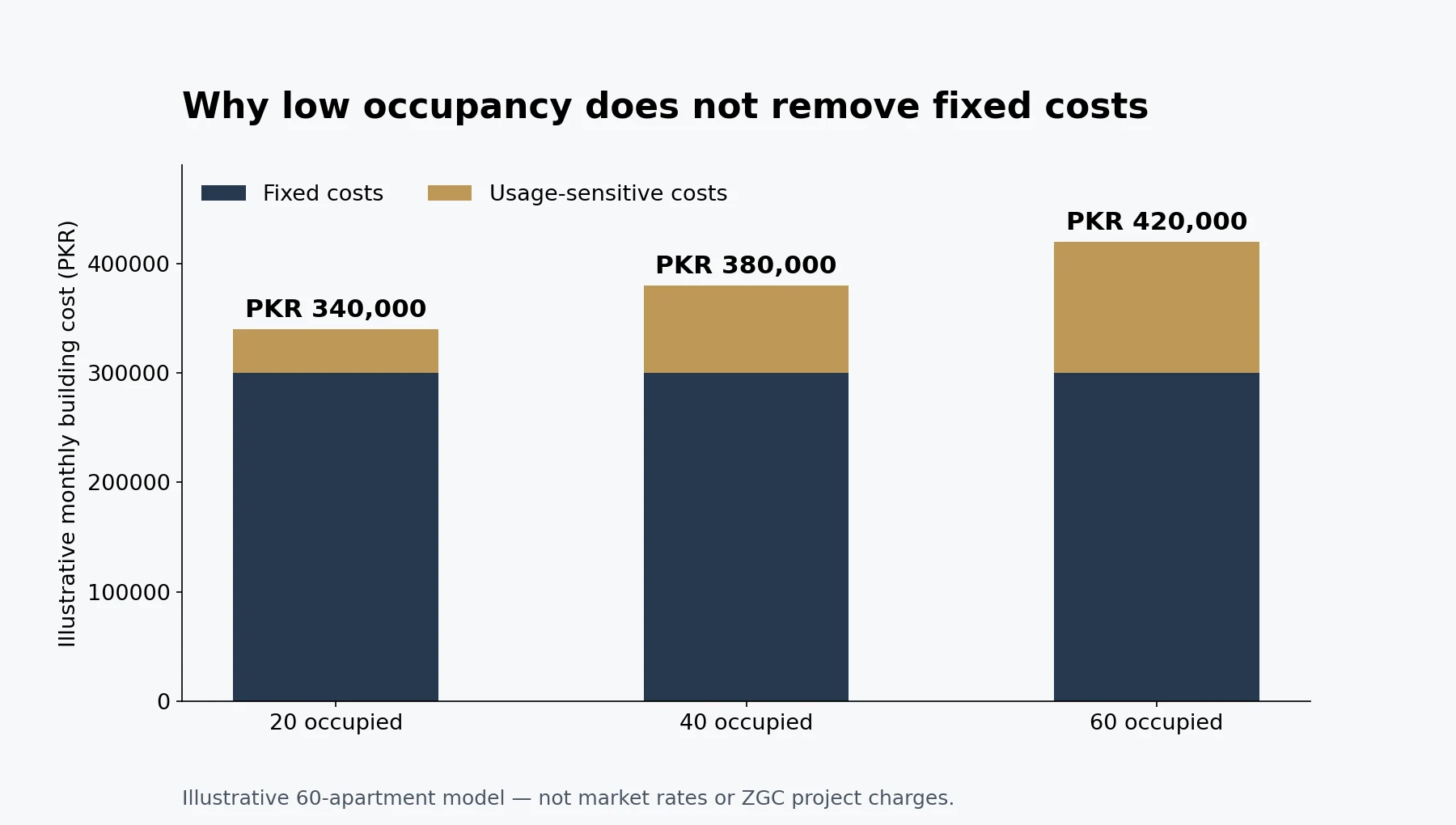
For this calculation only:
Monthly operating budget = PKR 300,000 + (PKR 2,000 × occupied apartments).
Real electricity, fuel and water costs do not necessarily move in a straight line with occupancy. Equipment can have minimum operating needs, and staffing or cleaning can change in steps. Request the building’s own assumptions instead of applying this model as a forecast.
| Scenario | Occupied apartments | Illustrative total operating cost | Equal charge if all 60 units contribute | Cost per occupied unit if only occupied units fund the budget |
|---|---|---|---|---|
| Low occupancy | 20 | PKR 340,000 | About PKR 5,667 | PKR 17,000 |
| Base occupancy | 40 | PKR 380,000 | About PKR 6,333 | PKR 9,500 |
| Full occupancy | 60 | PKR 420,000 | PKR 7,000 | PKR 7,000 |
The last column demonstrates a funding pressure, not an automatic right to charge occupied apartments more. Actual payment responsibilities must follow the applicable arrangements.
At low occupancy, ask who funds the difference if vacant units do not contribute on the same basis. If a developer or another party supports the budget temporarily, request its amount, duration and end conditions in writing.
Also ask whether the quoted service package will operate during that period. A low fee supported by reduced services is a different proposition from the same fee supporting the full advertised package.
Separate Vacant Apartments From Unpaid Bills
Occupancy tells you how many homes are being used. Collection tells you how much of the billed amount is actually received. Neither figure replaces the other.
Suppose all 60 apartments in our full-occupancy example are billed PKR 7,000. Total monthly billing is PKR 420,000. If only 80% is collected during that month:
- Cash received is PKR 336,000.
- The immediate operating cash shortfall is PKR 84,000.
- The unpaid amount remains an arrears issue; it does not disappear from the records.
Ask management how arrears are recorded and followed up, and how temporary cash shortfalls are handled. Whether another contribution can be requested is a separate contractual question.
This distinction helps you assess a reassuring statement such as “the monthly fee covers everything.” It may cover the approved budget on paper while collections are insufficient to pay current bills.
Maintenance Reserves: Who Pays When Major Equipment Needs Replacing?
An operating budget pays for the current service period. A replacement reserve sets money aside for identified future work, where the building’s arrangements provide for it.
Routine lift servicing and a major lift replacement are different expenses. The same distinction can apply to pumps, generators and larger common-property works.
International professional guidance, including the RICS residential service-charge management code, emphasises transparent management and planned maintenance. That code concerns residential management in England; it is a reference for budgeting principles here, not Pakistani law.
A Simple Reserve Calculation
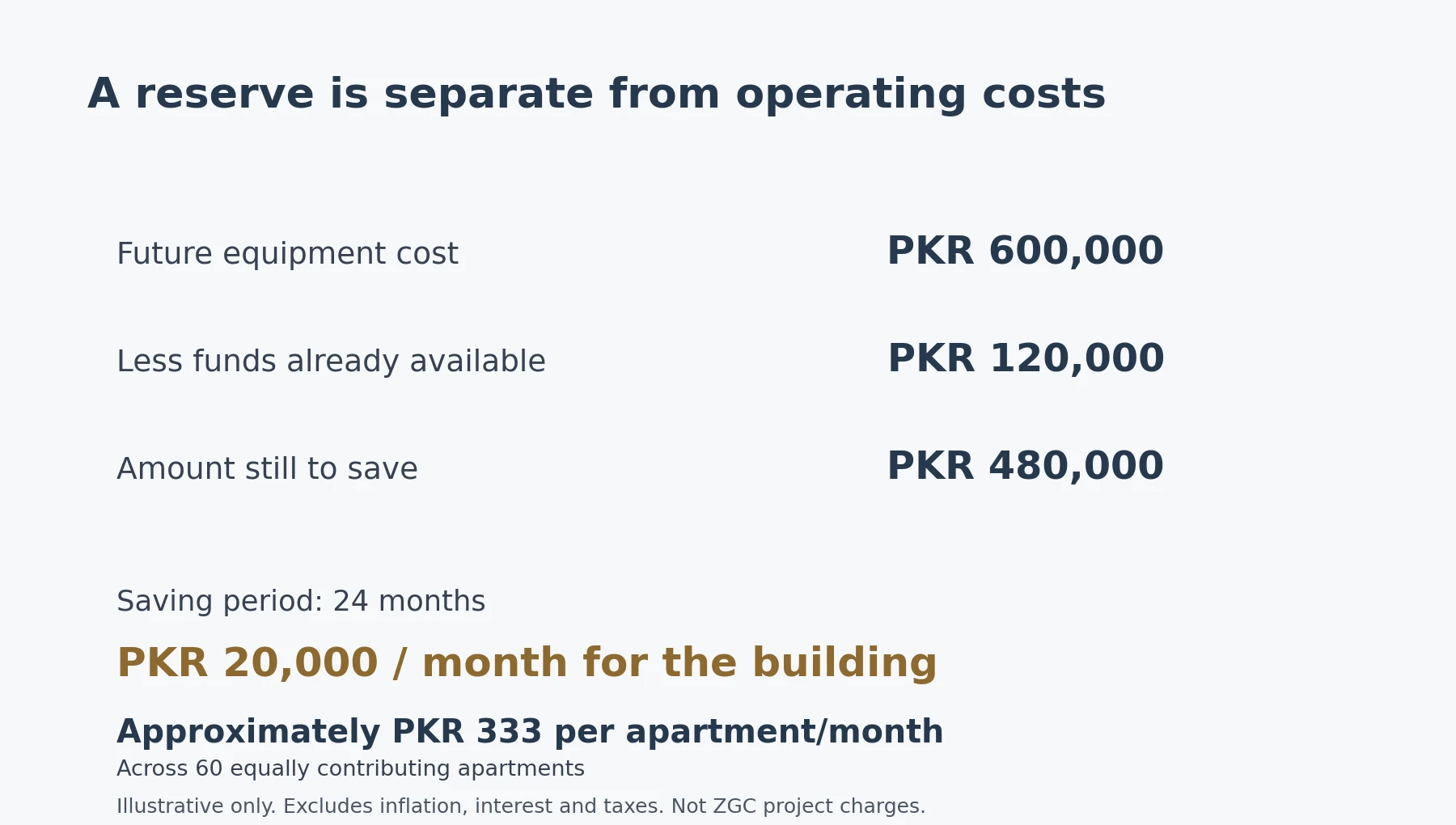
Assume a separately identified future shared-equipment expense is estimated at PKR 600,000, with PKR 120,000 already available for that purpose and 24 months to build the remaining amount.
Monthly reserve contribution = (PKR 600,000 − PKR 120,000) ÷ 24 = PKR 20,000 for the building.
Across 60 equally contributing apartments, that is approximately PKR 333 per apartment per month, in addition to the operating contribution.
This simplified example ignores inflation, interest, taxes and changing equipment condition. A real reserve plan needs a dated assessment of the asset, likely work, timing and funding already available.
Ask who holds the funds, who authorises expenditure and whether owners receive a statement showing the opening balance, contributions, spending and closing balance. A reserve contribution should have an identifiable purpose rather than function as an unexplained addition to the bill.
How to Compare Two Buildings Without Being Misled by the Headline Fee
Compare matching services over the same period. Do not compare one building’s base operating fee with another’s combined operating, usage and reserve bill.
| Comparison field | Building A | Building B |
|---|---|---|
| Quoted monthly operating contribution | Record amount | Record amount |
| Separate recurring water or backup charges | Record amount or calculation | Record amount or calculation |
| Replacement reserve contribution | Record amount, or ask how future work is funded | Record amount, or ask how future work is funded |
| Services and operating hours included | Attach written schedule | Attach written schedule |
| Allocation basis | Record agreed rule | Record agreed rule |
| Vacant-unit funding | Record responsible party | Record responsible party |
| Temporary support or introductory pricing | Record expiry and conditions | Record expiry and conditions |
| Budget evidence | Actual records, quotations or estimate | Actual records, quotations or estimate |
| Next review date | Record date | Record date |
This comparison belongs within your broader process for shortlisting apartment projects by budget, location and lifestyle.
Keep one-time purchase expenses separate. Documentation, transfer and initial connection costs belong in the acquisition budget; the guide to hidden costs in Karachi instalment projects addresses that wider issue.
For rental planning, identify which recurring charges the owner remains responsible for under the tenancy arrangements. Carry those expenses into your net rental-yield calculation rather than assuming the tenant pays every building cost.
A Copyable Maintenance-Budget Worksheet for Buyers
Use the following worksheet during a sales meeting or management discussion. Record the date and person providing each answer, and retain the relevant documents.
| Question | Answer or document reference | Evidence status |
|---|---|---|
| What is the current charge, and which period does it cover? | ______ | Supported / estimated / not supplied |
| Which services are included and excluded? | ______ | Supported / estimated / not supplied |
| What is the total building operating budget? | ______ | Supported / estimated / not supplied |
| Which costs are fixed and which depend on usage? | ______ | Supported / estimated / not supplied |
| How is my apartment’s contribution calculated? | ______ | Supported / estimated / not supplied |
| Who contributes for unsold and unoccupied units? | ______ | Supported / estimated / not supplied |
| Is there temporary funding, and when does it end? | ______ | Supported / estimated / not supplied |
| Are reserve contributions separately identified? | ______ | Supported / estimated / not supplied |
| How are budget revisions and actual expenditure reported? | ______ | Supported / estimated / not supplied |
| When does my payment obligation begin? | ______ | Supported / estimated / not supplied |
For a new project, several answers may reasonably remain estimates. The important next step is to identify who will confirm them and when. An unconfirmed estimate should remain visible in your household planning.
At possession, include the service schedule and management contact details in your apartment handover checks. Confirm which facilities are operational and how future service requests will be logged.
What Makes a Maintenance Quote Worth Investigating Further?
Pause for clarification when a quote lacks an itemised budget, relies on an unexplained occupancy assumption, or promises an unchanged fee without explaining changes in operating costs.
Other questions arise when generator fuel appears both inside and outside the base charge, a replacement reserve has no stated purpose, or nobody can explain the treatment of vacant units.
These observations do not independently establish wrongdoing. They identify gaps in the information needed to evaluate the apartment.
The quality of the answer matters: a dated explanation, a relevant document and a named responsible person give you something to assess. Repeated verbal reassurance leaves the underlying question open.
Ask for the Building Budget Before Choosing Your Apartment
A useful maintenance charge connects a clear service package with a credible budget and an understandable contribution rule. It should help you see both the cost of living in the building today and the responsibilities that may arise later.
When discussing a ZGC apartment, ask the team for the maintenance information available for that particular project: the current estimate or charge, inclusions, allocation basis and management arrangements. Confirm what is provisional before committing.
You can contact Zain Group of Companies with your household requirements and request the relevant project information alongside a viewing. Bring the worksheet so your comparison includes the building you will help operate, as well as the apartment you intend to own.
Frequently Asked Questions
What are apartment maintenance charges in Karachi?
They are recurring contributions towards shared building services and upkeep. Their scope can include cleaning, security, lift servicing and common-area systems. Ask for the written inclusions because water, backup usage, reserves and other items may be billed separately.
Is there a standard monthly maintenance rate for all Karachi apartments?
This guide does not establish a universal market rate. Assess the specific building’s budget, service package, contribution rules and applicable documents. The example amounts above demonstrate calculations and are not current price quotations.
How are apartment maintenance charges calculated?
The calculation depends on the documented allocation method. Equal allocation divides a shared cost pool by the number of contributing units. Area-weighted or service-specific arrangements require the corresponding allocation percentages or other stated rules.
Do vacant apartments have to contribute to maintenance?
Check the applicable agreement and management arrangements. Do not assume vacancy automatically removes an obligation, or that occupied residents must cover vacant units. Ask separately about unsold units, unoccupied owners’ apartments and unpaid bills.
Can apartment maintenance charges increase after possession?
Check whether the quoted amount is fixed, provisional or reviewable and what the documents say about revisions. Ask who can approve changes, what evidence supports them and how residents receive notice. A qualified adviser can assess disputed obligations.
Are generator fuel and water included in the monthly fee?
They may be included, separately billed or split between fixed and usage-related charges. Request a written breakdown covering the equipment or service supplied, allocation method and billing period. Do not infer whole-apartment backup coverage from a generator being present.
What is the difference between maintenance and a reserve fund?
Operating maintenance funds current services and routine upkeep. A reserve, where provided for, accumulates contributions for identified future work. Request separate figures and a clear explanation of how reserve money is held, authorised and reported.
What if management will not provide enough budget information?
Record the unanswered questions and request the relevant written explanation through the authorised channel. Before purchasing, assess whether you have enough information to accept the obligation. For an existing dispute, seek advice based on your documents rather than assuming withholding payment is appropriate.